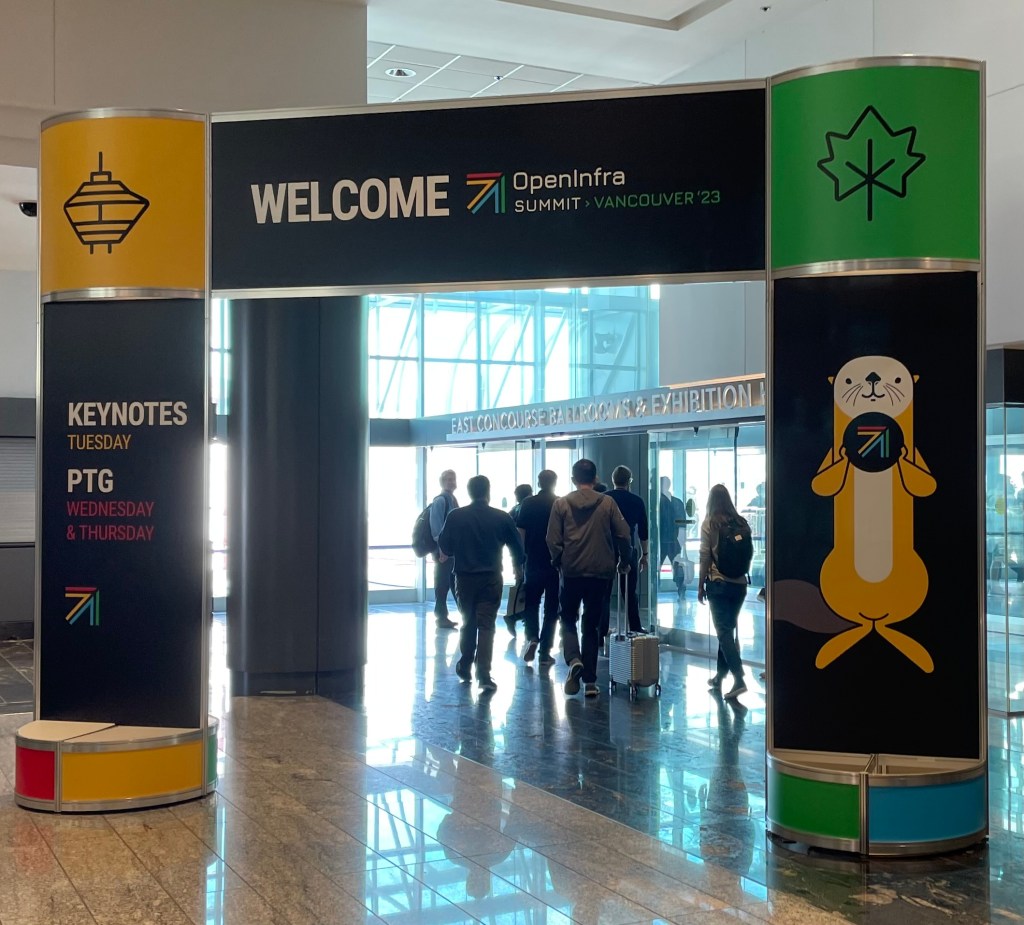
It had been a little over 4 years since I last attended an OpenInfra Summit in person, the last being the Denver summit in May 2019. Needless to say, I was extremely happy to be able to attend!
I arrived to Vancouver on Sunday evening. With how late the sun sets there (around 9.30pm) I was still able to make it to the hotel with sunlight out while using the comfortable SkyTrain rapid transit line that connected YVR with Vancouver City Centre.
I attended the OpenInfra board meeting where we discussed some of the updates and announcements to be made during the summit.
The OpenInfra Foundation announced the opening of two regional hubs, OpenInfra Europe and OpenInfra Asia, further highlighting the global aspect of the community and the importance of regional events in years to come. Especially considering the large number of people who reported being unable to attend the summit because of VISA delays. All in all, the summit was attended by around 750 people. Similar size to the previous summit in Berlin which I was unable to attend.
But while the number of attendees may have been lower, the number of cores that OpenStack is deployed is higher than ever, reaching 40 million.
I gave a talk on integrating OpenID Connect with OpenStack. I think it was well attended and well received. It was hard to fit a talk of that scope in the allotted 30 minutes, resulting in no time for questions.
Most of my time was spent attending forum discussions. These discussions are captured on Etherpads that are updated as the discussion progresses in real-time and serve as artifacts of the discussion.
The rest of my time was spent talking to community members, foundation staff members, and foundation board members about open source development, sustainable community building, and various pain points in the community. But most importantly non-work stuff, as that builds community and increases trust. Open Source is built by humans, after all, and we are social people.
Together with Ghanshyam Mann, we moderated the forum session OpenStack Technical Committee + Community Leaders Interaction. We have this session every PTG with the purpose of eliciting feedback from the community to drive the priorities and actions of the TC. We discussed the CI timing out and the various solutions available to increase visibility into slow jobs. We also discussed the need for the TC to step in and provide a push towards completing the SQL Alchemy 2.0 migration for the projects where that is yet to be completed. Finally, we discussed Storyboard and the state of projects moving back to Launchpad for their issue tracker.
I attended the forum discussion about Extended Maintenance. While there was a short time slot and the discussion couldn’t proceed much further than setting the context and a shared understanding, to me it felt that there was agreement on keeping EM branches up and open but also surprise from the attendees on the amount of effort from the maintainers to keep those branches working and patched, pointing to a misalignment in communication. So there is a need (and there was no pushback) in renaming this to something that signals clearly that the branch is not maintained. I will be collecting the feedback and proposing some solutions forward in a message to the mailing list in the coming days that will be further discussed in the TC weekly meeting on June 27.
During the internationalization forum discussion we reiterated the for someone to work on the integration with Weblate, after the lack of development that the current solution, Zanata, is receiving. We also merged this as an Upstream Investment Opportunity, which is a TC mechanism for highlighting areas where the community could use some help. The time for this session was also very limited and was mostly spent on setting the context and demonstrating the current process of translations with Zanata. It might be valuable to investigate allowing translations for select governance documents, like Upstream Investment Opportunities.
During the Keystone PTG we approved a specification proposing support for external Token Introspection endpoints in Keystonemiddleware. This would allow for a potential deployment of OpenStack without Keystone, with caveats. We also approved some revisions to the core reviewers groups and synced up with the RBAC effort.
The Kubernetes on OpenStack forum session was the longest forum session of the summit, running at 1 hour 30 minutes in a room fully packed. There were a lot of users running their Kubernetes clusters on OpenStack and discussing their pain points, such as ETCD performance. There was excitement over the recently announced integration between OpenStack Magnum and the Cluster API.
During a talk by Kendall Nelson about university partnerships of the OpenInfra Foundation, Boston University was mentioned. The talk highlighted the cloud computing class and senior design course and made a call for other universities to participate as OpenInfra Associate members.
It is uncertain what type of format the next summit will have, but I’m hopeful that the future of Open Infra is looking great and I’m excited to be a part of it.
 Kristi Nikolla